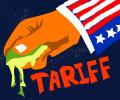
The US is "pretty close" to reaching a "fair trade deal" with India, President Donald Trump has said, adding that he will lower the tariffs imposed on Indian goods at "some point".

Former White House trade advisor Peter Navarro accuses India of being an 'oil money laundromat' for Russia, alleging that India's oil purchases are funding Putin's war in Ukraine. The accusations come amid existing trade tensions and tariffs imposed by the US.

'As far as the contentious issues such as agriculture are concerned, we are finding some common ground.'
Reliance Industries' refining earnings will remain steady, supported by its position as India's largest importer of Russian crude and favourable global supplies, according to analysts at JM Financial and Goldman Sachs. Reliance imported more Russian barrels than any other Indian refiner in the past eight months, according to data from Bloomberg/Kpler.

The Russians have termed Putin's visit to India, his first to this country since the outbreak of the Russia-Ukraine war, as 'Druzhba Dosti', which means 'friendship' in Russian and Hindi respectively.

'An asset must generate income. Equities yield dividends, bonds pay coupons, deposits give interest, and real estate earns rent.' 'Gold, silver, and even Bitcoin produce no income, they merely store value. So, they should not be compared to productive assets.'

If India caves in to US pressure as Trump hopes it will, he will further try to blackmail it into submission, points out Ramesh Menon.

The additional 25 per cent tariff imposed by US President Donald Trump on India is set to deliver a major blow to West Bengal's export-driven economy, with the state's labour-intensive leather, engineering and marine sectors expecting losses ahead of the festive season, stakeholders said. The increased levies on Indian products for the country's purchases of Russian oil came into effect on Wednesday, bringing the total amount of tariff imposed on New Delhi to 50 per cent.

The enduring relationship between the two countries have survived the disintegration of the erstwhile USSR in 1991, the end of the Cold War and the regime change in both countries, points out Rup Narayan Das.
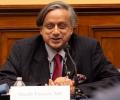
Senior Congress leader Shashi Tharoor says US tariffs are negatively impacting India, leading to job losses, and criticizes President Trump's diplomatic behavior.

Russian oil giant PJSC Rosneft Oil Company is in early talks with Reliance Industries for sale of its 49.13 per cent stake in Nayara Energy, which operates a 20-million tonnes-a-year oil refinery and 6,750 petrol pumps in India, sources said. Reliance has held preliminary talks for acquisition of Nayara, which will help it overtake state-owned Indian Oil Corporation (IOC) to become India's No.1 oil refiner as well as give a meaningful presence in the fuel marketing space.
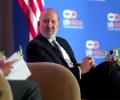
Lutnick said that these countries have to understand that if "you want to sell to the US consumers, you've got to play ball with the President of the United States."
India's brittle energy security is inextricably linked to two opposing paradigms - fossil fuels, and the transition to green energy. The first powers the present; the second paves the way for Viksit Bharat in 2047.

India has implemented a number of free trade agreements with developed nations and is in active dialogue for such pacts with nations including the US, Oman, and the EU, Commerce and Industry Minister Piyush Goyal said. India has implemented trade pacts with Australia, the UAE and EFTA bloc. It has also signed an agreement with the UK.

The wide-ranging sanctions imposed by the US on the Russian oil sector have started to dent near-term oil flows to India with state-owned Bharat Petroleum Corporation Ltd (BPCL) saying not enough cargoes are available for March.

India is already importing 80 per cent of oil and 25 per cent its gas requirements.

Communication channels between India and the US are open to resolve the ongoing tariff issues, and the glitch in trade ties is only temporary, given the long-term relationship between the two nations, government sources said on Wednesday. The US' 50 per cent tariffs on Indian exports to America came into effect from August 27, barring a few sectors.
Chief Economic Advisor V Anantha Nageswaran on Thursday said he expects that a solution to the tariff issues with the US is likely to be arrived in the next eight to ten weeks.

Meeks, a ranking member of the House Foreign Affairs Committee Democrats, on Wednesday (local time) underscored "Congress' support for the US-India partnership," following his meeting with Indian Ambassador to the US Vinay Mohan Kwatra.

India should simultaneously prioritise domestic exploration and production of more oil and gas in the country, and ensure we retain diversified suppliers for imports, points out former foreign secretary Ranjan Mathai.
US President Donald Trump has announced a 25 per cent plus tariff on India from Aug 1. Trump, describing India as a "friend", said the US has done relatively "little business" with the country because of its high tariffs.
Donald Trump's tariffs, meant as political punishment, have avoided the predicted chaos, lifting US growth, weakening rivals, and letting him claim victory in a resilient global economy, observes T T Ram Mohan.

'Geopolitically and diplomatically it's a very difficult situation for India.'
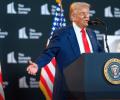
The comments come ahead of Trump's high-profile meeting with Russian President Vladimir Putin, scheduled for Friday in Anchorage, Alaska.
Trump said California has been particularly "hard hit" because of this, blaming democrat Gavin Newsom, the Governor of California, for this loss, calling him "weak and incompetent."
With the India-US trade talks moving in the right direction, Commerce and Industry Minister Piyush Goyal is expected to visit Washington soon, sources said.

From labelling India the 'Tariff King' to slapping sweeping import duties, US President Donald Trump has steadily hardened his trade stance on India. These announcements are being seen as a pressure tactic to get New Delhi to agree to demands made by the US in the proposed Bilateral Trade Agreement (BTA).
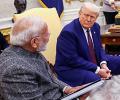
To those who ask, "Is all this really worth it? Why can't domestic demand fill the gap?", it is important to remind them that only 13 economies since the Second World War have grown at 7 per cent or more for 25 years -- like India needs to. They all had one thing in common: Strong export growth underpinned by strong global engagement, explains Sajjid Z Chinoy.

State governments have requested the Centre for export incentives, lifting of import duty in the case of cotton for the textile sector and GST exemptions.

India has become Apple's main export hub to the US, which consumes over $40 billion worth of iPhones annually.
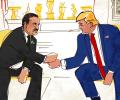
'We have a great leader coming, the prime minister of Pakistan and the field marshal.'

Trump couldn't care less anymore about the Israeli demand for Iran's 'de-nuclearisation' and 'de-militarisation.' Trump pins hopes on a grand bargain with Iran as a partner in America First, argues Ambassador M K Bhadrakumar.

'What India has done will surely embolden more countries to stand up to Trump.'
The Indian team has returned from the US after holding trade talks with their American counterparts in New York, an official said on Thursday. Commerce and Industry Minister Piyush Goyal, who led the team, will be back on Friday.
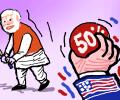
'Things may get much worse before they get better,' predicts Ajay Chhibber.
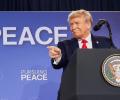
Notably, US President Donald Trump and his administration have continuously targeted India over its purchase of Russian crude oil. India, on the other hand, has always maintained that India's purchases are based on its domestic needs and economic security.
'When negotiators meet next, they may like to bring new issues to the table.'

The decision to hike US H-1B visa application fee to $100,000, trade talks and the GST rate cut will be the key drivers for stock market movement this week, analysts said.

The latest flashpoint in West Asia has derailed India's preliminary plans to resume crude oil imports from Iran, officials said. In January, officials of the Ministry of Petroleum and Natural Gas had told Business Standard that the government had been studying proposals for the same, given that India was trying to expand sources of imports. "We are always monitoring the situation when it comes to crude flows.

Prime Minister Narendra Modi conveyed to Ukrainian President Volodymyr Zelenskyy that India remains committed to making every possible contribution for an early and peaceful solution to the conflict. Zelenskyy sought India's support in limiting Russian energy exports.
